
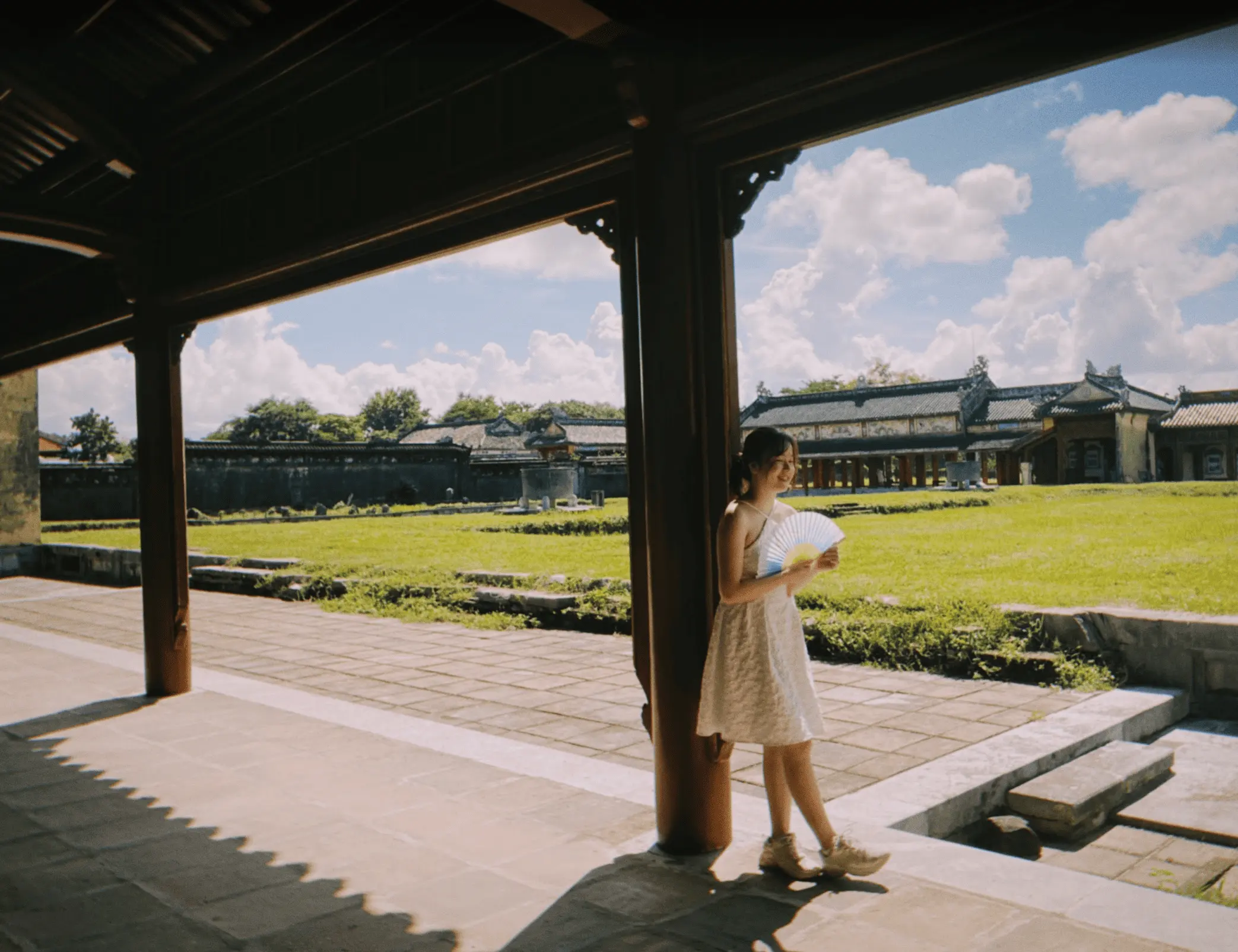
This Hue Vietnam travel guide explores one of the most atmospheric cities in Vietnam – a place where history, food, and quiet moments come together.
There’s a reason people who visit Hue always seem a little softer when they come back. The city doesn’t overwhelm you, it settles into you. The light is hazy, the streets are quieter, the food hits deeper, and somewhere between a crumbling palace gate and a bowl of bún bò (Hue spicy beef noodle soup) at six in the morning, you start to understand what it means for a place to carry centuries of memory in its bones.
Best Time to Visit Hue
Hue has a famously tricky climate. The city sits in a rain shadow zone that catches the worst of the central Vietnamese monsoon. February to April is ideal time to visit this dreamy city. The weather is dry, temperatures are warm but not brutal (mid-20s°C), and the city is at its most beautiful, clear skies over the Citadel, the Perfume River glassy and calm. May to August is hot and sunny, perfectly fine if you don’t mind the heat. September to November is peak rainy season and Hue floods (not dramatically), but streets do go underwater and outdoor sightseeing becomes genuinely difficult. December and January are cool and overcast, with occasional drizzle, kind of moody and atmospheric if that’s your thing, but pack a light jacket.
If you’re planning a trip to Da Nang, be sure to check out my travel guide to Da Nang and Hoi An. If the weather looks good, take a short trip to Hue. It’s only a few hours away and worth visiting even on a grey day.
Getting To Hue By Train
Yes, you can get a car from Da Nang to Hue. It takes about the same time, costs about the same money but it will never be the same experience.
Book your sleeper train at dsvn.vn. Choose a soft-sleeper berth and this is the important part – request the right-side seats (seats facing the sea when heading north). The train hugs the coastline through the famous Hai Van Pass, and for a stretch of roughly 20–30 minutes, the ocean opens up below you like a painting you weren’t ready for: deep blue water, crashing waves, isolated fishing coves, and mountains plunging straight into the sea.

The Hai Van Pass (Hải Vân literally means “Sea Cloud”) sits at over 490 metres above sea level and was historically the natural border between the old kingdoms of Đai Viet and Champa. For centuries, whoever controlled this mountain pass controlled the fate of central Vietnam. Today, a tunnel carries most traffic underneath it, meaning the train route above remains one of the most scenic rail journeys in Southeast Asia, largely unchanged and unhurried.
The journey takes roughly 2.5–3 hours. Bring snacks, find your berth, and let the mountains and the sea do the rest.
Hue Vietnam Travel Guide: What to Know First
Hue was the imperial capital of Vietnam under the Nguyen dynasty from 1802 to 1945 (the last royal dynasty in Vietnamese history). For over 140 years, this was the political, spiritual, and cultural heart of a unified Vietnam. Emperors were crowned here. Royal cuisine was invented here. And when Emperor Bao Đai abdicated in August 1945, handing power to Ho Chi Minh’s new government, it marked the end of Vietnamese monarchy forever.
The city sits on both banks of the Sông Hương (the Perfume River), named for the wildflowers that once drifted downstream from the hills and has been a UNESCO World Heritage Site since 1993. It’s slower than Đa Nang, more melancholy, and in the best possible way, more Vietnamese.
What to See in Hue
Đại Nội Huế – The Imperial Citadel
The heart of this Hue Vietnam travel guide is the citadel.
Open 7AM–5:30PM daily | Entry: 200,000 VND (~$8) | Audio guide: +100,000 VND (~$4)
If you do one thing in Hue, make it this. The Imperial Citadel is a massive walled complex covering nearly 600 hectares, built beginning in 1804 under Emperor Gia Long as a near-replica of Beijing’s Forbidden City, adapted to Vietnamese aesthetic and spiritual traditions.
Inside the outer walls lies the Imperial City, and at its heart, the Forbidden Purple City (Tử Cấm Thành) once reserved exclusively for the emperor and his closest attendants, on pain of death. Much of the complex was damaged or destroyed during the 1968 Lunar New Year Offensive, and restoration is ongoing, which means wandering here feels both grand and slightly ruined perhaps more honest for it.


A few things to look out for: the Ngọ Môn Gate (the main ceremonial entrance, where Emperor Bao Đai made his abdication speech), the beautifully restored Điện Thái Hòa (Palace of Supreme Harmony), and the Royal Theatre, which still hosts traditional court music performances at 10AM and 3PM daily.

Arrive before 8AM to beat the heat and the crowds. Wear comfortable shoes because the complex is enormous and you’ll want 2–4 hours at minimum. The audio guide genuinely adds depth. You can also rent traditional clothes and take some beautiful pictures here.
Làng Hương Thủy Xuân – The Incense Village
About 7km south of the city center, the village of Thủy Xuân has been producing incense sticks for generations. What makes it extraordinary and irresistible for photographers is the way the artisans display their product: enormous bundles of incense stacked in perfect circular arrangements, or leaned in dramatic fans against the walls, in vivid shades of pink, red, purple, and yellow.
The craft itself is meditative to watch. Incense workers roll bamboo sticks by hand through fragrant paste (a mix of wood powder, aromatic herbs, and natural dye) then lay them out in the sun to dry. The whole process takes several days, and the air around the village carries a warm, slightly spiced sweetness that you’ll keep trying to describe for weeks after.
Come in the morning for the best light, and bring some patience. The vendors are welcoming but the shops are small and popular. If you plan to buy, compare a few before committing.
The Walking Street & Tràng Tiền Bridge
As evening falls, the walking street along Nguyen Đinh Chieu comes alive with food stalls, craft vendors, and a cool river breeze. At the heart of it all is Trang Tien bridge built by the French between 1897 and 1899, stretching 402 metres across the Perfume River, damaged during the 1968 Lunar New Year Offensive, and today beautifully illuminated in slow-changing colours after dark. Walk it at night, watch it reflect in the water, then stay for everything else the riverbank has to offer.

Along the waterfront you’ll find vendors selling lotus-shaped paper lanterns – a Buddhist tradition with roots in ancestral offerings and prayers, particularly tied to Hue’s deep royal connection to the faith. Light the candle, make a wish, and release. Watching a cluster of warm orange lights drift upward over the dark river is one of those travel moments you don’t forget.

From the docks nearby, wooden boats depart from around 8PM for ca Hue performances (UNESCO-recognised traditional chamber music developed in the Nguyen royal courts), played live on instruments like the đàn tranh (zither) and đàn bầu (monochord) as the boat drifts slowly under the bridge and back. Tickets can be booked at the dock or through your guesthouse.
Trường Quốc Học Huế (Hue High School for the Gifted)
12 Lê Lợi, Vĩnh Ninh
Standing quietly on Le Loi Street along the southern bank of the Perfume River, Trường Quốc Học looks at first like a beautiful piece with red brick walls, a grand ceremonial gate, a neatly kept courtyard. It’s only when you learn who walked through those gates that the weight of the place settles in.

Founded in 1896 by the French colonial government as a school to train Vietnamese civil servants in both Vietnamese and Western education, Quốc Học quickly became something its founders almost certainly didn’t intend: a crucible of Vietnamese revolutionary thought. Among its students were Ho Chi Minh (who attended around 1908), Vo Nguyen Giap (the military strategist who would later defeat both France and the United States), and Pham Van Đong (who became Prime Minister of Vietnam for over 30 years).
The school is still an active high school today, so you won’t be able to wander inside during term time. But the exterior, especially the iconic gate and the view from across Lê Lợi toward the Perfume River, is absolutely worth a quiet stop. It pairs naturally with a walk along the riverbank toward Tràng Tiền Bridge, just five minutes away on foot.
What to Eat in Hue
Huế food deserves its own thesis. The city’s culinary tradition developed under royal patronage, emperors demanded variety and beauty from their kitchens, and the result is a cuisine that emphasizes small, intricate dishes, bold flavors, and an obsession with technique that hasn’t faded. Don’t rush this part.
Breakfast
Bún Bò Loan – 158b Phan Chu Trinh
The city’s most iconic dish, done right. Loan’s bún bò Huế is famous for its giant springy crab balls and a lemongrass-and-shrimp-paste broth that’s bold without being overwhelming. Arrive by 6:30AM, it fills up fast and the best cuts go early.
Bánh Cuốn – 48 Nguyễn Công Trứ
If you want something lighter, soft steamed rice rolls filled with pork and mushroom make a quieter, equally good start to the day. Opens early, runs out before noon.
The Essential Bánh Experience
Quán Bánh Chi – 52 Lê Viết Lượng

Order the combo plate (~80–100k for two) and get everything: bánh bèo (steamed rice saucers with dried shrimp), bánh nậm (flat banana-leaf parcels of pork and shrimp), bánh lọc (chewy tapioca dumplings with whole shrimp), and the crowd favourite bánh ram ít (a crispy fried base topped with a soft glutinous dumpling). The textural contrast on that last one alone is worth the trip.
Afternoon Snacks
Tài Phú – 2 Điện Biên Phủ
Go here for bánh khoái (Huế’s crispier, thicker cousin of bánh xèo), nem lụi (grilled pork on lemongrass skewers), and bún thịt nướng. All served with the same addictive peanut-sesame dipping sauce.
Bánh Mì Ô Thọ – 14 Trần Cao Vân
Thin, crackling crust, generous pâté, pickled vegetables. One of the city’s best bánh mì and a great quick snack between sights.
Dinner
Nhà Hàng Chạn – 1 Nguyễn Thái Học

The standout dinner in Huế. Traditional home cooking such as gỏi, cá kho tộ (caramelised clay-pot fish), thịt luộc chấm mắm nêm in a beautiful courtyard setting that somehow still feels local. Reserve ahead, especially on weekends.
Desserts
Huế is Vietnam’s chè capital – a tradition that goes back to the royal kitchens. Skip the tourist cafés and look for a gánh chè (a roaming street vendor) or a chè hẻm tucked into a residential alley. Try chè hạt sen (lotus seed), chè đậu ngự (Huế’s own purple bean variety), or chè bắp (sweet corn in coconut cream).
Local specialty
64 Kiệt 7 Ứng Bình, Vỹ Dạ

Cold rice topped with tiny river clams, pork crackling, peanuts, fermented shrimp paste, and chilli, which is sharp, funky, and deeply local. Hoa Đông sits on Cồn Hến island, where the dish was born. Ultra cheap, zero frills, and it’ll tell you more about Huế than any museum.
A Few Thoughts
This Hue Vietnam travel guide isn’t about rushing. Hue rewards slowness. Don’t try to tick everything off in half a day. Rent a bicycle in the morning, get lost in the streets around the Citadel, let yourself be drawn into an alley by the sound of someone cooking.
The city has known war, dynasty, colonialism, and radical change. Through all of it, the food stayed. The river stayed. The incense smoke kept rising. That, in itself, feels like something worth sitting with.
Have any questions or experiences to share? Kindly drop a comment below!





Leave a Comment